Real Estate Investor Lead Follow-Up Across Calls, SMS, Email, and Socials
A real estate investor can spend heavily on lead generation and still lose deals for one ordinary reason: the follow-up feels fragmented. A seller fills out a form, gets a call they miss, receives a text two days later from a different number, sees an email with no context, and then gets silence for a week. By the time someone on the acquisitions side finally has a real conversation, trust is thin and the seller has either cooled off or moved on.
That problem gets bigger as lead volume rises. It is manageable when an operator works a handful of seller leads by memory and instinct. It breaks when campaigns start producing a steady stream of motivated seller leads from PPC, SEO, cold calling, or SMS outreach. At that point, process matters more than hustle. You need a real estate follow up system that connects calls, SMS, email, and social channels into one conversation, not four disconnected attempts.
For investors, this is where real estate automation stops being a convenience and becomes operational discipline. Not every message should be automated. Not every seller should receive the same cadence. But without a framework, even talented acquisitions reps miss obvious windows. The lead was warm at 11:15 a.m. And dead by 4:00 p.m. Because nobody responded in time.
The real job of follow-up
Investor follow-up is often described as persistence. That is only partly right. Persistence matters, but the real job is to reduce friction at each point of contact. A seller who is thinking about a fast sale, a problem tenant, an inherited property, or a house with deferred maintenance is rarely looking for a polished sales funnel. They are looking for clarity, speed, and a sense that they are dealing with someone competent.
Calls, texts, emails, and social messages each do a different part of that job.
A call creates tone and can surface motivation quickly. You can hear hesitation, urgency, confusion, and resistance within seconds. SMS lowers pressure and gets responses from people who ignore unknown numbers. Email gives you room to confirm details, summarize next steps, and keep a written record. Socials can capture the leads who live in their DMs more than their inboxes, though this is usually a secondary channel rather than the center of a serious acquisition process.
The mistake I see most often is treating these channels as separate campaigns. A seller does not experience them that way. They experience one relationship. If your real estate investor CRM cannot preserve that continuity, your follow-up will always feel scattered.
What a multi-channel seller workflow actually looks like
When a new lead comes in, speed matters, but sequence matters too. A missed inbound call should not wait until tomorrow. A web form from a high-intent page should not get buried under outbound cold leads. A text response that says “yes, interested” should not sit idle while the team is calling less engaged records.
A useful real estate lead management workflow usually starts with intent. Where did the lead come from, and what did they do? Someone who called your number has signaled more urgency than someone who clicked a general ad and skimmed a page. Someone who filled in property details has given you context that should carry into the first call and first text.
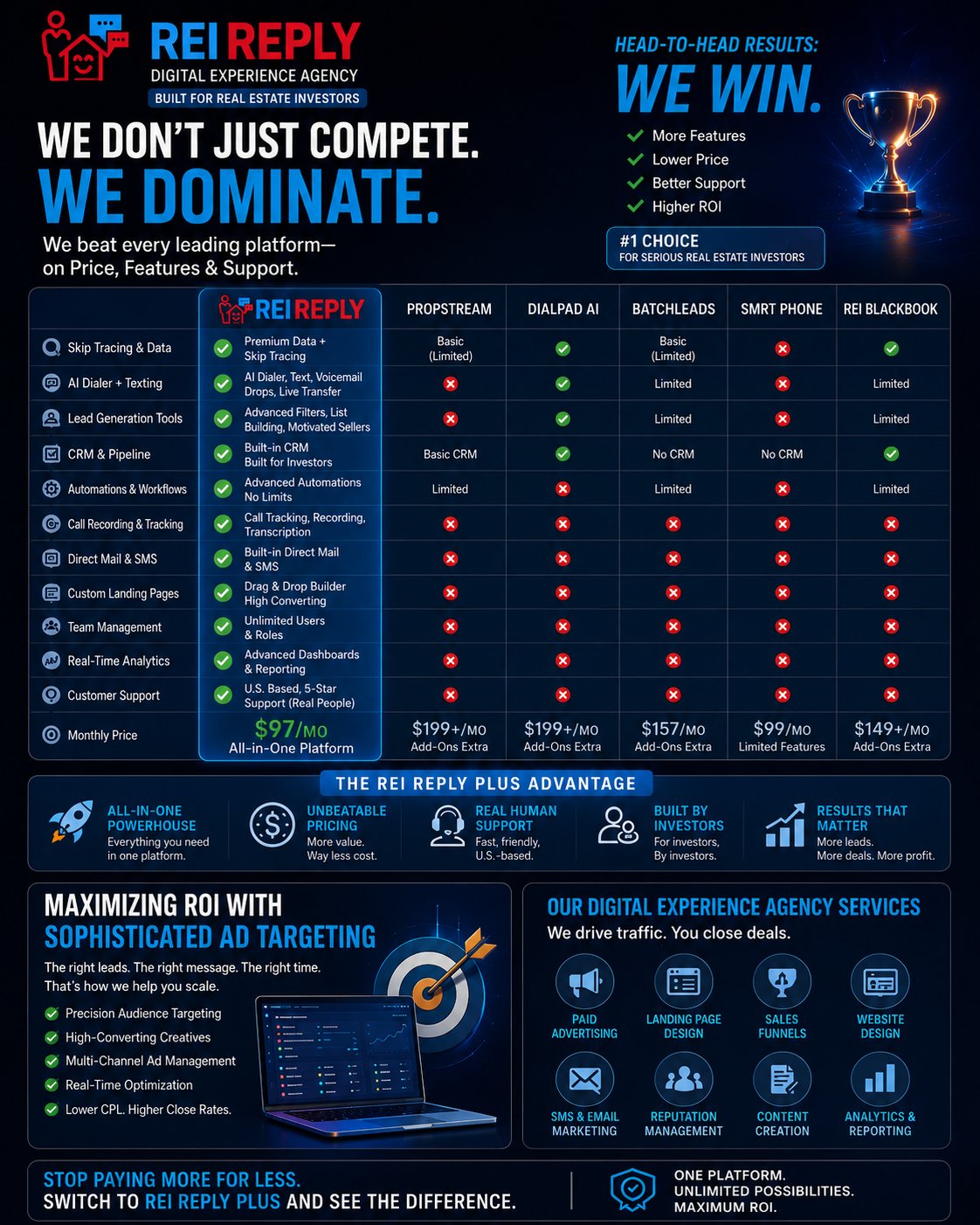
This is why investor-focused software matters. REI Reply positions itself as a CRM and follow-up system built specifically for real estate investors, combining inbound and outbound calling, SMS, missed-call text back, and AI voice assistants in one platform. That matters because investor operations are different from a generic sales team. Wholesalers, fix-and-flippers, buy-and-hold investors, and acquisitions teams are often juggling varied lead sources and trying to convert conversations into appointments fast. REI Reply also presents itself as a conversion engine rather than a lead provider, although its subscription includes access to verified motivated seller data through REI AI Leads.
That distinction is important. A lot of frustration in this business gets blamed on bad leads when the actual issue is weak conversion. Real estate investor leads often decay because response time slips, context is lost between channels, or the handoff from automation to a human is clumsy. Better software does not make every seller motivated. What it can do is preserve the opportunity when motivation is present.
Where AI actually helps, and where it should stay in its lane
There is a lot of noise around AI for real estate investors. Some of it is marketing, some of it is useful, and some of it creates more problems than it solves.
Used well, real estate AI is not about replacing acquisitions. It is about handling the parts of lead follow up that humans routinely fumble under workload. Immediate acknowledgment, after-hours responses, repetitive qualification questions, appointment reminders, and routine reactivation are obvious examples. If a seller reaches out at 9:40 p.m., an AI voice agent or automated SMS flow can keep that lead warm until a team member is available. If someone misses your call, missed-call text back can recover conversations that would otherwise disappear.
REI Reply states that its AI voice agent can qualify leads, book appointments, and follow up around the clock across calls, SMS, email, and socials. For an acquisitions team, that has practical value. A seller inquiry does not care whether your office is open. If your real estate investor software can acknowledge interest immediately and keep the conversation moving, you preserve momentum.
Still, judgment belongs with humans. Seller motivation is rarely a neat checkbox. One owner says they are “just seeing what offers look like” but reveals in minute four that a code violation hearing is next week. Another sounds urgent in text but goes cold the moment pricing comes up. AI lead qualification can help gather facts and sort traffic, but price sensitivity, emotional complexity, family decision dynamics, and credibility concerns still need a real person.
That is the trade-off with AI lead follow up and AI lead management. It is excellent at consistency. It is weaker at nuance. The winning setup uses both. Let automation do the fast, repetitive, and time-sensitive work. Let humans handle negotiation, trust-building, and the gray areas where a deal is really won.
Why SMS carries more weight than many investors admit
Among all follow-up channels, SMS marketing for real estate investors tends to punch above its weight because it meets sellers where they already are. People ignore calls. They skim email. They read texts. Not always immediately, but often enough that real estate SMS marketing has become central to seller lead follow up.
That does not mean more volume is automatically better. It means texting needs to be specific, timely, and compliant. A vague “just checking in” text is almost useless. A relevant text that references the property, a prior call, or the seller’s request can reopen the conversation. The best real estate investor texting feels like an ongoing exchange, not a broadcast.
Texting also works best when tied closely to the rest of the system. If your acquisitions rep speaks to a lead at noon and your automated text message goes out at 12:05 as if no conversation happened, you look disorganized. On the other hand, if the system sends a confirmation, a next-step note, or a reminder that fits the call, the seller experiences continuity. That is what real estate SMS automation should do.
There is also a deliverability layer that investors cannot afford to ignore. In the United States, A2P 10DLC is the carrier standard for application-to-person SMS traffic sent through 10-digit long code numbers, intended to ensure that messages are verified and consensual. For anyone doing automated SMS for real estate investors, this is not a technical side issue. It affects whether messages get through and whether your texting program stays usable over time.
REI Reply advertises messaging features such as Spintax and text-deliverability-oriented tools like Humanizer. For teams doing real estate SMS automation at scale, that signals an effort to improve message variation and delivery practices. Even so, no feature excuses sloppy strategy. If your texts are irrelevant, too frequent, or disconnected from seller intent, software cannot rescue the conversation.
Compliance is not a footnote
A surprising number of investor teams still treat compliance as something to clean up later. That is a mistake, especially when you are working across calls and texts at scale.
The FTC says telemarketers must honor Do Not Call rules, may not use the National Registry or company-specific DNC lists for any purpose other than compliance, and generally may not call outside 8 a.m. To 9 p.m. Local time without prior consent. The FTC also says prerecorded telemarketing calls require prior signed, written agreement, and that consent can be obtained electronically if E-SIGN requirements are met.
For real estate investors, those rules are not abstract. They affect how you build call campaigns, how you manage your data, how you train staff, and how you configure automation.
Here are the compliance checkpoints that deserve constant attention:
- Respect calling time windows based on the lead’s local time.
- Maintain and honor entity-specific Do Not Call procedures.
- Use DNC-related information only for compliance purposes.
- Treat prerecorded telemarketing calls as a separate consent issue.
- Make sure your SMS setup aligns with A2P 10DLC registration requirements.
That is not glamorous work, but it protects the business. The more you rely on real estate investor automation, the more important these guardrails become. Automation multiplies both good systems and bad habits.
Skip tracing, data quality, and the cost of bad contact records
No follow-up engine can overcome poor lead data forever. If the number is wrong, the owner is misidentified, or the record lacks context, your team spends energy chasing noise. That is why conversations about real estate skip tracing and property owner lookup belong inside the follow-up discussion, not outside it.

Investors usually think of skip tracing for real estate investors as a top-of-funnel function. Find property owner phone number, append contact data, and start outreach. In practice, data quality shapes every stage after that. A bad phone number leads to failed calls and wasted SMS spend. Missing owner details create awkward conversations. Poorly organized property data make it harder to tailor follow-up.
REI Reply states that subscribers get access to verified motivated seller data through REI AI Leads. For operators trying to tighten their lead generation automation and follow-up speed, having data and follow-up tools in the same environment can reduce friction. The value is not magical data. The value is less disconnect between sourcing, outreach, and conversion.
That said, no real estate investor data source is perfect. Teams still need standards for data hygiene. If a contact bounces between channels, somebody should verify whether the issue is wrong information, carrier filtering, seller reluctance, or simple timing. Too many organizations blame the lead when the underlying problem is that nobody owns record quality.
A practical cadence across calls, SMS, email, and socials
The strongest seller lead automation does not bombard people. It escalates intelligently. It also adapts to channel preference. Some owners will text back within minutes and never answer a call. Others ignore every text but pick up on the second call attempt. Some want details in email because they are coordinating with siblings or a spouse. Socials are useful for edge cases, especially when other channels have gone quiet but the relationship still feels alive.

A sensible sequence might look like this in principle: an immediate response on the channel that triggered the inquiry, a call attempt while intent is fresh, a text that references the interaction if the call is missed, and an email that captures the details and next step. From there, the cadence should widen rather than intensify, unless the seller shows new activity.
The important part is cohesion. The text should know about the missed call. The next call should know about the text reply. The email should reflect the actual property and timing issue. This is where a real estate AI CRM or AI CRM for real estate investors can earn its place, not by sounding clever, but by keeping context intact.
What to automate, what to keep human
A lot of teams over-automate early and then have to unwind the damage. Sellers can tell when they are trapped in a rigid sequence. They may not know the software, but they feel the mismatch. The art is in deciding which moments benefit from consistency and which require discretion.
These are usually the best places to automate:
- Immediate lead acknowledgment
- Missed-call text back
- Appointment confirmations and reminders
- Routine nurture for unready leads
- Re-engagement after long inactivity
Everything beyond that deserves a close look. Automated lead qualification is useful if it gathers information that helps a human have a better call. It is less useful if it turns into a maze. AI seller conversations should move the lead forward, not keep the lead busy.
One rule I have found reliable is simple: if the next step depends on empathy, negotiation, or reading between the lines, a person should probably take over. If the next step depends on speed, repetition, or memory, automation is usually the better choice.
The acquisitions handoff is where many systems fail
Most investor teams obsess over lead generation and underinvest in handoff quality. Yet the moment a lead moves from automated seller follow up into an acquisitions conversation is where value either compounds or evaporates.
A good handoff gives the rep enough context to sound prepared without sounding scripted. They should know the source, the property, the prior messages, and any qualification details already captured. They should not have to ask the seller to repeat everything. Nothing kills trust faster than making a motivated seller restate the entire reason they reached out.
This is where purpose-built real estate investor CRM systems can outperform general tools. Investors do not just need contact records. They need a working real estate https://propertyinvesting466.greyhavendaily.com/posts/off-market-property-lead-generation-using-verified-motivated-seller-data sales pipeline that reflects how acquisition actually happens: new inquiry, contact made, qualification in progress, appointment set, offer discussion, follow-up, dead lead, or nurture. If the CRM is not designed around that motion, teams create workarounds, and workarounds usually break under volume.
REI Reply positions itself around this investor-specific use case. For teams managing motivated seller follow up across calling, texting, and other channels, that focus matters. The system is aimed at conversion and coordination, not just storage.
Why some leads close months later
One final point deserves more attention than it usually gets. Not every good lead is ready now. Some of the best deals come from long-cycle follow-up where the initial conversation went nowhere obvious. The seller was uncertain, the family was split, the tenant issue had not forced action yet, or the timing simply was not right.
This is why lead nurturing real estate work needs structure. A lead that is not ready today is not the same as a dead lead. It may need monthly contact, a periodic call, or a simple text anchored to the seller’s stated timeline. Good real estate follow up automation can keep those threads alive without making the outreach feel relentless.
Investors who win consistently tend to understand this rhythm. They move fast when the lead is hot, and they stay organized when the lead is not. They do not depend on memory. They do not let channels compete with each other. They build one coherent system for seller lead follow up and then refine it based on actual conversations.
The practical goal is not more activity. It is more relevance, delivered faster, with less friction. Calls give you voice. SMS gives you immediacy. Email gives you clarity. Socials give you one more door when the others are quiet. Put together well, they create a follow-up process that feels personal at scale, which is exactly what a real estate investor needs when every missed response can cost a deal.